
Description
The master task manages and controls the instrument as a physics-acquisition device. It controls instrument activity, including physics acquisition, charge-injection calibration, and subsystem diagnostics (for diagnostics based on the "event path").
The slave tasks provide the CPU horsepower for compute-intensive tasks, including physics data filtering and charge-injection calibration.
These tasks can operate in any of several modes, including Event Taking, Calibration, Diagnostic, and Idle (quiescent). Before any of these modes can begin, however, the tasks must perform the Configuration phase.
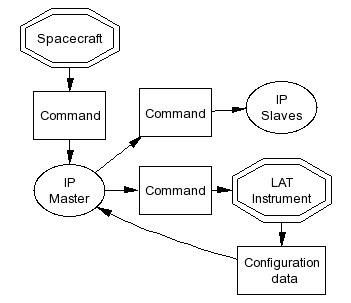
See also: annotated data flow animation
In Event Taking mode (the primary operation mode), the tasks filter event messages. This is discussed, in detail, in the Event Filtering tutorial.
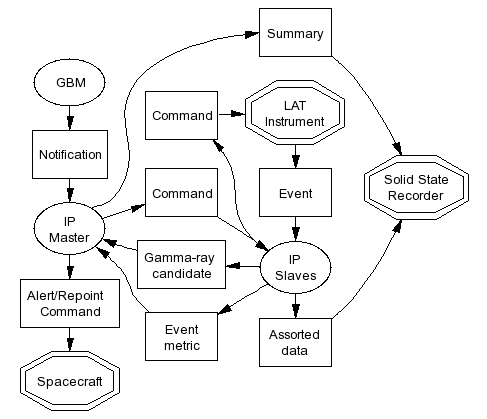
See also: annotated data flow animation
Calibration mode is used to collect quantitative data on the LAT instrument (e.g., systematic biases). In this mode, the tasks provide artificial signals to portions of the instrument, collecting the resulting data.
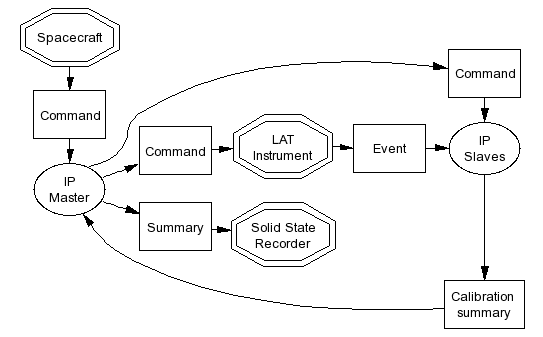
See also: annotated data flow animation
Diagnostic mode is used to collect qualitative data on the LAT instrument (e.g., component functionality). In this mode, the tasks operate subsets of the instrument, looking for expected behavior.
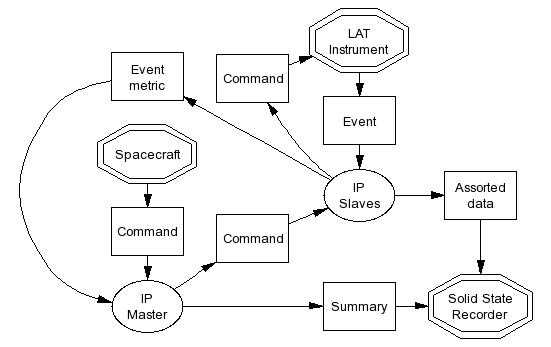
See also: annotated data flow animation
Role: Master
CPU(s): SIU only
Input
-
The 1553 Receive Service task sends spacecraft telecommand packets to this task.
The GBM Interrupt task sends a notification message to this task.
The LCB Receive Service task sends LAT internal-protocol packets to this task.
Output
The Master task sends requests for operations to its slave tasks.
Package(s)
-
LCI: "LAT Charge Injection (Calibration)"
LDF: "LAT Diagnostics Framework"
LPA: "LAT Physics Acquisition"
LRA: "LAT Register Access"
Role: Slaves
CPU(s): EPUs
Input
-
The Instrument Physics Master task sends requests for operations to this task.
The LCB Receive Service task sends LAT internal-protocol packets to this task.
The Watchdog Slave tasks send status interrogation requests to this task.
Output
The task sends science and calibration data to the Solid State Recorder.
Package(s)
-
LCI: "LAT Charge Injection (Calibration)"
LDF: "LAT Diagnostics Framework"
LPA: "LAT Physics Acquisition"
LRA: "LAT Register Access"
Function(s)
"Configure ACD front-end electronics""Configure GASU (i.e., CRU, GEM, EBM, AEM)"
"Configure PDU"
"Configure TKR and CAL front-end electronics"
"Configure by compressed file"
"Emulated event delivery (to science data interface)"
"Real event delivery (instrument to CPU)"