
Req. 5.3.9.1: "Event Filter Rates and Capacity"
The FSW shall filter the input stream of events accepted by the electronic trigger to an output stream commensurate with the spacecraft (SC) interface rate (up to 66 Mbps) and capacity (a maximum of 104 Gb in any given 24 hour period), keeping events meeting the science objectives. Note that the 104 Gb allocation includes a total source packet overhead of 112 bits per packet (64 bits of the secondary header are for a time stamp).
Basis (help)
[1] (3.3.2.1.4-5), [2] (3.2.5.4.1, 3.2.5.4.5), [4] (5.4.3)
-
1: "Mission System Spec." (NASA 433-SPEC-0001)
3.3.2.1.4: "Data Acquisition"
The observatory shall be designed to accommodate instrument data rates and volumes as defined in the LAT and GBM IRDs.
3.3.2.1.5: "Data Storage"
The observatory shall have the capability to acquire and store up to 30 hours of science and 36 hours of housekeeping data between telemetry contacts.
3.2.5.4.1: "LAT to SC Interface Data Rate"
The LAT-SC total aggregate data rate on the dedicated science data interface shall accommodate data throughput up to 48 Mbps.
3.2.5.4.5: "Data Volume"
The LAT shall provide to the SC a maximum of 104 gigabits of high rate science data in any given 24 hour period.
Note: This allocation also includes a total source packet overhead of 112 bits per packet (64 bits of the secondary header are for a time stamp).
5.4.3: "Event Data Filtering Function"
The dataflow system shall reduce the event rate accepted by the L1T to an output rate commensurate with the spacecraft interface as specified in 433-IRD-0001, keeping events meeting the science objectives.
Context (help)
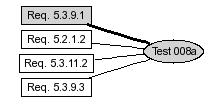
Test(s)
008a: Event Filtering - Reception of Events and Verification of Filtering Algorithm
This test shall confirm that fully assembled, properly formatted events are received directly into EPU memory, where they can be processed by EPU FSW. This test shall also verify that the on-board filtering algorithms running on the EPU(s) achieve the purity/efficiency ratios predicted by Monte Carlo. The test shall include running a specific set of scenarios derived from Monte Carlo simulations with known, expected results. The filtering algorithms must provide acceptable results for each scenario in order to pass this test.