#include <DictNode.h>
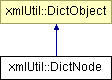
Inheritance diagram for xmlUtil::DictNode::
Public Methods | |
| DictNode (DOM_Element elt, DictNode *parent, DictFieldMan *fieldMan) | |
| Construct a node from its XML representation (probably recursively construct children as well). More... | |
| ~DictNode () | |
| const DictField & | getField () const |
| const DictConstraints & | getValueConstraints () const |
| const DictConstraints & | getParentConstraints () const |
| bool | accept (DictVisitor *vis) |
| bool | consistentChildren () |
| Check that collection of children define appropriately disjoint collections of Identifiers. In the process may do some sorting of child nodes, so these functions are not const. More... | |
| bool | consistentParent () |
| Verify that parent constraints, if any, are consistent with other restrictions on values parent node may take on. More... | |
| bool | consistentValues () |
| Verify that constraints (if any) on node's own value are consistent with constraints on field. More... | |
| bool | allowed (const unsigned value) const |
| bool | allowedChild (std::string childField, unsigned childValue, unsigned myValue) const |
| Are the given child field name, child field value, and value this node compatible with defn of node and children? More... | |
| bool | allowedChild (unsigned childValue, unsigned myValue) const |
| Are the given child field value, and value this node compatible with defn of node and children? More... | |
| bool | allowIdentifier (const Identifier &id, NamedId *named=0) |
| Given an identifier, see if it is "allowed" by this node and a sequence of its descendents. If there is a non-null NamedId argument, build up the associated NamedId. More... | |
| bool | allowNamedId (const NamedId &nId) |
| return true iff there is a path starting with current node which could produce the NamedId nId. More... | |
| bool | allowNameSeq (const NameSeq &seq) const |
| return true iff there is a path starting with current node such that node field names match those in seq. More... | |
Private Types | |
| typedef std::vector< DictNode *> | Nodes |
| typedef std::vector< DictNode *>::iterator | NodeIterator |
| typedef std::vector< DictNode *>::const_iterator | ConstNodeIterator |
Private Methods | |
| const Nodes & | getChildren () const |
| bool | allowedChild (const DictNode *const thisChild, unsigned childValue, unsigned myValue) const |
| Is the particular child node compatible with the given childValue and value for this? More... | |
| bool | allowIdentifier (Identifier::const_iterator idIt, Identifier::const_iterator end, NamedId *named=0) |
| Called by version without iterators. More... | |
| bool | allowNamedId (NamedId::FieldIt nIdIt, NamedId::FieldIt end) |
| Called by version with simple NamedId rather than iterators. More... | |
| bool | allowNameSeq (NameSeq::const_iterator seqIt, NameSeq::const_iterator end) const |
| called by version with simple NameSeq arg rather than iterators. More... | |
| bool | addChild (DictNode *child) |
| bool | valuesDisjoint (ConstNodeIterator start, ConstNodeIterator last) |
| Check that for nodes in the interval demarcated by [first, last] value constraints give pairwise-disjoint sets. More... | |
| DictNode (const DictNode &toCopy) | |
| Copy constructor copies all children, grandchildren, etc. More... | |
| DictNode & | operator= (const DictNode &) |
| void | deepCopy (const DictNode &toCopy) |
| DictNode () | |
| don't allow uninitialized node. More... | |
Static Private Methods | |
| void | setOstream (std::ostream *out) |
| The following may be called by IdDict during, e.g., validation. More... | |
Private Attributes | |
| Nodes | m_children |
| collection of child nodes. More... | |
| const DictField * | m_field |
| id field for this node. More... | |
| const DictNode * | m_parent |
| parent dictnode. More... | |
| DictConstraints * | m_parConstraints |
| Constraints on values of parent. More... | |
| DictConstraints * | m_myConstraints |
| Constraints on values for this node. More... | |
Static Private Attributes | |
| std::ostream * | m_err = &(std::cout) |
Friends | |
| class | IdDict |
| class | IdConverter |
| struct | POrder |
|
|
Definition at line 96 of file DictNode.h. Referenced by accept(), allowedChild(), allowIdentifier(), allowNamedId(), allowNameSeq(), consistentChildren(), deepCopy(), setOstream(), and valuesDisjoint(). |
|
|
Definition at line 95 of file DictNode.h. Referenced by ~DictNode(). |
|
|
Definition at line 94 of file DictNode.h. Referenced by getChildren(). |
|
||||||||||||||||
|
Construct a node from its XML representation (probably recursively construct children as well).
Definition at line 11 of file DictNode.cxx. References allowed(), consistentChildren(), DictNode(), m_children, m_field, m_myConstraints, and m_parConstraints. Referenced by allowIdentifier(), allowNamedId(), allowNameSeq(), deepCopy(), DictNode(), and setOstream().
00012 : 00013 m_children(0), m_parent(parent), m_parConstraints(0), 00014 m_myConstraints(0) { 00015 // check element type is OK. Shouldn't be a problem if 00016 // the xml file validates. Note sense of assert is: 00017 // abort program if assertion is *false* 00018 assert( (elt.getTagName().equals("dictNode")) || 00019 (elt.getTagName().equals("dictRoot")) ) ; 00020 00021 // Field name stuff: 00022 std::string fName = 00023 std::string(xml::Dom::transToChar(elt.getAttribute("fieldName"))); 00024 00025 m_field = fieldMan->find(fName.c_str()); 00026 assert(m_field != 0); 00027 // Do something if it doesn't exist?? Shouldn't be terribly 00028 // necessary by ID/IDREF mechanism 00029 00030 DOM_Element child = xml::Dom::getFirstChildElement(elt); 00031 // Could be a leaf with no children 00032 if (child == DOM_Element()) return; 00033 00034 if ((child.getTagName()).equals("pValues")) { // parent constraints 00035 DOM_Element gChild = xml::Dom::getFirstChildElement(child); 00036 m_parConstraints = new DictConstraints(gChild); 00037 00038 // check for compatibility 00039 DictConstraints* fromParent = 0; 00040 if (parent->m_myConstraints) fromParent = (parent->m_myConstraints); 00041 else { 00042 fromParent = parent->m_field->getConstraints(); 00043 } 00044 if (fromParent) { 00045 bool allowed = (fromParent->allowed(m_parConstraints)); 00046 if (!allowed) { 00047 assert(allowed); 00048 } 00049 } 00050 child = xml::Dom::getSiblingElement(child); 00051 if (child == DOM_Element()) return; // new Dec. 4 00052 } 00053 00054 // Next up we might have our own constraint 00055 if (!(child.getTagName().equals("dictNode")) ) { 00056 m_myConstraints = new DictConstraints(child); 00057 00058 // Check it's consistent with constraints on our own field, 00059 // if any 00060 DictConstraints* fCon = m_field->getConstraints(); 00061 if (fCon != 0) { 00062 assert(fCon->allowed(m_myConstraints)); 00063 } 00064 child = xml::Dom::getSiblingElement(child); 00065 } 00066 00067 // All that's left are child nodes, if any 00068 00069 while (child != DOM_Element()) { 00070 DictNode *nextChild = new DictNode(child, this, fieldMan); 00071 00072 m_children.push_back(nextChild); 00073 child = xml::Dom::getSiblingElement(child); 00074 } 00075 // Finally, how about checking for consistency among children? 00076 if (!consistentChildren()) { 00077 std::cout << "Inconsistent children, fieldname " << 00078 m_field->getName(); 00079 // make a fuss 00080 } 00081 } |
|
|
Definition at line 453 of file DictNode.cxx. References m_children, m_myConstraints, m_parConstraints, and NodeIterator.
00453                       {
00454     if (m_parConstraints != 0) {
00455       delete m_parConstraints;
00456       m_parConstraints = 0;
00457     }
00458     if (m_myConstraints != 0) {
00459       delete m_myConstraints;
00460       m_myConstraints = 0;
00461     }
00462     for (NodeIterator it = m_children.begin();
00463          it != m_children.end(); ++it) {
00464       delete *it;
00465     }
00466   }
|
|
|
Copy constructor copies all children, grandchildren, etc.
Definition at line 414 of file DictNode.cxx. References deepCopy().
00414                                            : DictObject(toCopy) {
00415     deepCopy(toCopy);
00416   }
|
|
|
don't allow uninitialized node.
Definition at line 159 of file DictNode.h. Referenced by deepCopy(), and DictNode().
00159 {};
|
|
|
Reimplemented from xmlUtil::DictObject. Definition at line 402 of file DictNode.cxx. References ConstNodeIterator, and m_children.
00402                                         {
00403     // Call back visitor for child nodes, then self
00404
00405     for (ConstNodeIterator it = m_children.begin(); it != m_children.end();
00406          it++) {
00407       bool keepGoing = (*it)->accept(vis);
00408       if (!keepGoing) return false;
00409     }
00410
00411     return  vis->visitNode(this);
00412   }
|
|
|
Definition at line 390 of file DictNode.cxx. References m_children, and m_myConstraints. Referenced by deepCopy().
00390                                           {
00391     if ((m_myConstraints != 0) & (child->m_parConstraints != 0)) {
00392       if (!(m_myConstraints->allowed(child->m_parConstraints))) return false;
00393     }
00394     m_children.push_back(child);
00395     return true;
00396   }
|
|
|
Definition at line 262 of file DictNode.cxx. References m_field, and m_myConstraints. Referenced by allowedChild(), allowIdentifier(), allowNamedId(), and DictNode().
00262                                                    {
00263     if (!m_myConstraints) {
00264       return m_field->allowed(value);
00265     }
00266     else {
00267       return m_myConstraints->allowed(value);
00268     }
00269   }
|
|
||||||||||||||||
|
Is the particular child node compatible with the given childValue and value for this? Assume we've already checked that this node may take on myValue; still need to check that for the child indicated myValue is allowed. Definition at line 296 of file DictNode.cxx.
00297                                                       {
00298     if (child->m_parConstraints) {
00299       if (!(child->m_parConstraints)->allowed(myValue)) return false;
00300     }
00301     return child->allowed(childValue);
00302   }
|
|
||||||||||||
|
Are the given child field value, and value this node compatible with defn of node and children?
Definition at line 285 of file DictNode.cxx. References allowed(), allowedChild(), ConstNodeIterator, and m_children.
00286                                                        {
00287
00288     if (!allowed(myValue)) return false;
00289     for (ConstNodeIterator it = m_children.begin(); it != m_children.end();
00290          ++it) {
00291       if  (allowedChild(*it, childValue, myValue)) return true;
00292     }
00293     return false;
00294   }
|
|
||||||||||||||||
|
Are the given child field name, child field value, and value this node compatible with defn of node and children?
Definition at line 271 of file DictNode.cxx. References allowed(), ConstNodeIterator, and m_children. Referenced by allowedChild().
00272                                                        {
00273     if (!allowed(myValue)) return false;
00274
00275     for (ConstNodeIterator it = m_children.begin(); it != m_children.end();
00276          ++it) {
00277       if (  ((*it)->getField()).getName() == childField) {
00278         return allowedChild(*it, childValue, myValue);
00279       }
00280     }
00281     // Never found child with correct field name
00282     return false;
00283   }
|
|
||||||||||||||||
|
Called by version without iterators.
Definition at line 304 of file DictNode.cxx. References allowed(), ConstNodeIterator, DictNode(), m_children, and m_field.
00306                                                  {
00307     if (!allowed(*idIt)) return false;
00308     if (named != 0) named->addField(m_field->getName(), *idIt);
00309     Identifier::const_iterator tmp = idIt;
00310     ++tmp;
00311     if (tmp == end) return true;
00312
00313     //look for children allowing our value for parent node
00314     for (ConstNodeIterator it = m_children.begin(); it != m_children.end();
00315          it++) {
00316       DictNode *child = *it;
00317       if ( (child->m_parConstraints == 0) ||
00318            (child->m_parConstraints->allowed(*idIt)) ) {
00319         if (child->allowIdentifier(++idIt, end, named)) return true;
00320       }
00321     }
00322     // Didn't work out so remove ourselves
00323     if (named != 0) named->popField();
00324     return false;
00325   }
|
|
||||||||||||
|
Given an identifier, see if it is "allowed" by this node and a sequence of its descendents. If there is a non-null NamedId argument, build up the associated NamedId.
Definition at line 327 of file DictNode.cxx.
00327                                                                      {
00328     Identifier::const_iterator idIt = id.begin();
00329     return allowIdentifier(idIt, id.end(), named);
00330   }
|
|
||||||||||||
|
Called by version with simple NamedId rather than iterators.
Definition at line 337 of file DictNode.cxx. References allowed(), ConstNodeIterator, DictNode(), m_children, and m_field.
00338                                                   {
00339     // Check information for first field matches
00340
00341     // These aren't supposed to happen
00342     if (nIdIt == end) return true;
00343     if (!(*nIdIt)) return false;
00344
00345     if ( ((*nIdIt)->name).compare(m_field->getName()) ) return false;
00346     if (!allowed((*nIdIt)->value) ) return false;
00347
00348     NamedId::FieldIt tmp = nIdIt;
00349     ++tmp;
00350     if (tmp == end) return true; //done
00351
00352     // Now search children for match of remaining fields
00353     for (ConstNodeIterator it = m_children.begin(); it != m_children.end();
00354          it++) {
00355       DictNode *child = *it;
00356       if ( (child->m_parConstraints == 0) ||
00357            (child->m_parConstraints->allowed((*nIdIt)->value) ) ) {
00358         if (child->allowNamedId(++nIdIt, end) ) return true;
00359       }
00360     }
00361     return false;
00362   }
|
|
|
return true iff there is a path starting with current node which could produce the NamedId nId.
Definition at line 332 of file DictNode.cxx.
00332                                                 {
00333     NamedId::FieldIt nIdIt = nId.m_fields->begin();
00334     return allowNamedId(nIdIt, nId.m_fields->end());
00335   }
|
|
||||||||||||
|
called by version with simple NameSeq arg rather than iterators.
Definition at line 369 of file DictNode.cxx. References ConstNodeIterator, DictNode(), m_children, and m_field.
00370                                                                {
00371     if (seqIt == end) return true;
00372     if ( (*seqIt)->compare(m_field->getName())  ) return false;
00373
00374     NameSeq::const_iterator tmp = seqIt;
00375     ++tmp;
00376     if (tmp == end) return true; // done
00377
00378     // Now search children for match of remaining fields
00379     for (ConstNodeIterator it = m_children.begin(); it != m_children.end();
00380          it++) {
00381       DictNode *child = *it;
00382       if (child->allowNameSeq(++seqIt, end) ) return true;
00383     }
00384     return false;
00385
00386     /* TO DO */
00387   }
|
|
|
return true iff there is a path starting with current node such that node field names match those in seq.
Definition at line 364 of file DictNode.cxx. References xmlUtil::NameSeq.
00364                                                       {
00365     NameSeq::const_iterator seqIt = seq.begin();
00366     return allowNameSeq(seqIt, seq.end());
00367   }
|
|
|
Check that collection of children define appropriately disjoint collections of Identifiers. In the process may do some sorting of child nodes, so these functions are not const.
Definition at line 92 of file DictNode.cxx. References ConstNodeIterator, m_children, m_field, POrder, and valuesDisjoint(). Referenced by DictNode().
00092                                     {
00093     if (m_children.size() < 2) return true; // most common case
00094
00095     // Either all children must have parent-value constraints or
00096     // none can.
00097     ConstNodeIterator it = m_children.begin();
00098     bool childMode = ((*it)->m_parConstraints != 0);
00099     ++it;
00100     for (; it < m_children.end(); ++it) {
00101       if (((*it)->m_parConstraints != 0) != childMode) {
00102         (*m_err) << "Mixed parent-constraint mode among children "
00103                  << std::endl;
00104         (*m_err) << "Current node has field name " << this->m_field->getName()
00105                  << std::endl;
00106         return false;
00107       }
00108     }
00109     if (!childMode) { // no parent constraints
00110       return valuesDisjoint(m_children.begin(), m_children.end());
00111     }
00112
00113     // Otherwise sort nodes by minValue of parent constraint
00114     POrder parOrder;
00115     std::sort(m_children.begin(), m_children.end(), parOrder);
00116
00117     // Check that parent constraints are disjoint or identical
00118     for (it = m_children.begin(); (it + 1) != m_children.end(); ++it) {
00119       DictConstraints *par1 = (*it)->m_parConstraints;
00120       DictConstraints *par2 = (*(it + 1))->m_parConstraints;
00121
00122       if (  (!par1->equals(*par2)) &&
00123             (!par1->disjoint(*par2))  ) {
00124         (*m_err) << "Non-disjoint parent constraints among children"
00125                  << std::endl;
00126         (*m_err) << "Current node has field name " << this->m_field->getName()
00127                  << std::endl;
00128         return false;
00129       }
00130     }
00131
00132     // Finally need to check that child values are disjoint
00133     // within subcollection of nodes with same parent constraints
00134     it = m_children.begin();
00135     while (it  != m_children.end() ) {
00136       ConstNodeIterator follow = it + 1;
00137       unsigned   ourMin = (*it)->m_parConstraints->getMin();
00138
00139       // If we're ever starting a new collection to check at the
00140       // last child, we're done
00141       if (follow == m_children.end()) return true;
00142       while (follow != m_children.end()) {
00143         DictConstraints *par2 = (*follow)->m_parConstraints;
00144
00145         if (par2->getMin() != ourMin) {
00146           --follow;
00147           break;
00148         }
00149         ++follow;
00150
00151       }
00152       // If we got here, it's time to check out a collection of children
00153       bool ok = valuesDisjoint(it, follow);
00154       if (!ok) {
00155         (*m_err) <<
00156           "Non-disjoint values for children with same parent constraints"
00157                  << std::endl;
00158         (*m_err) << "Current node has field name " << this->m_field->getName()
00159                  << std::endl;
00160         return false;
00161       }
00162
00163       // Otherwise see if there is another bunch left
00164       it = ++follow;
00165     }
00166     return true;
00167   }
|
|
|
Verify that parent constraints, if any, are consistent with other restrictions on values parent node may take on.
Definition at line 169 of file DictNode.cxx. References m_field, m_parConstraints, and m_parent.
00169                                   {
00170     if (!m_parConstraints) return true;
00171
00172     if (DictConstraints *parConstraints = m_parent->m_myConstraints) {
00173       bool ok = parConstraints->allowed(*m_parConstraints);
00174       if (!ok) {
00175         (*m_err) <<
00176           "Parent value constraints and local parent constraints inconsistent"
00177                  << std::endl;
00178         (*m_err) << "Current node has field name " << this->m_field->getName()
00179                  << std::endl;
00180
00181         return ok;
00182       }
00183     }
00184     else if (DictConstraints *parConstraints =
00185              m_parent->m_field->getConstraints()) {
00186       bool ok = parConstraints->allowed(*m_parConstraints);
00187       if (!ok) {
00188         (*m_err) <<
00189           "Global value constraints on parent, local parent constraints clash"
00190                  << std::endl;
00191         (*m_err) << "Current node has field name " << this->m_field->getName()
00192                  << std::endl;
00193       }
00194       return ok;
00195     }
00196     return true;
00197   }
|
|
|
Verify that constraints (if any) on node's own value are consistent with constraints on field.
Definition at line 199 of file DictNode.cxx. References m_field, and m_myConstraints.
00199                                   {
00200     if (!m_myConstraints) return true;
00201
00202     DictConstraints *fieldConstraints = m_field->getConstraints();
00203
00204     if (!fieldConstraints) return true;
00205
00206     bool ok= fieldConstraints->allowed(*m_myConstraints);
00207     if (!ok) {
00208       (*m_err) << "local value constraints and global field constraints clash"
00209                << std::endl;
00210       (*m_err) << "Current node has field name " << this->m_field->getName()
00211                  << std::endl;
00212     }
00213     return ok;
00214   }
|
|
|
Definition at line 422 of file DictNode.cxx. References addChild(), ConstNodeIterator, DictNode(), m_field, m_myConstraints, m_parConstraints, and m_parent. Referenced by DictNode().
00422                                            {
00423     // Don't copy parent.  Nodes created with copy constructor
00424     // are parentless.  Use addChild after creation.
00425     // Also have to get parent constraints some other way
00426     m_parent = 0;
00427     m_parConstraints = 0;
00428     if (d.m_field) {
00429       m_field = new DictField(*(d.m_field));
00430     }
00431     else m_field = 0;
00432
00433     if (d.m_myConstraints) {
00434       m_myConstraints = new DictConstraints(*(d.m_myConstraints));
00435     }
00436     else m_myConstraints = 0;
00437
00438     // Now for child nodes
00439     for (ConstNodeIterator it = d.m_children.begin();
00440          it != d.m_children.end(); ++it) {
00441       DictNode *newChild = new DictNode(**it);
00442       DictConstraints *oldParConstraints = (*it)->m_parConstraints;
00443
00444       newChild->m_parConstraints = (oldParConstraints) ?
00445         new DictConstraints(*oldParConstraints) : 0;
00446       // Need some exception handling here.  addChild returns
00447       // true or false, depending on whether child actually was
00448       // added or not.
00449       addChild(newChild);
00450     }
00451   }
|
|
|
Definition at line 106 of file DictNode.h. References m_children, and Nodes.
00106 {return m_children;}
|
|
|
Definition at line 31 of file DictNode.h. References m_field.
00031 {return *m_field;};
|
|
|
Definition at line 39 of file DictNode.h. References m_parConstraints, and xmlUtil::NameSeq.
00039                                                         {
00040       return *m_parConstraints;};
|
|
|
Definition at line 37 of file DictNode.h. References m_myConstraints.
00037                                                        {
00038       return *m_myConstraints;};
|
|
|
Definition at line 418 of file DictNode.cxx.
00418                                                  {
00419     throw No_Assignment();
00420   }
|
|
|
The following may be called by IdDict during, e.g., validation.
Definition at line 109 of file DictNode.h. References ConstNodeIterator, DictNode(), and m_err.
00109 {m_err = out;}
|
|
||||||||||||
|
Check that for nodes in the interval demarcated by [first, last] value constraints give pairwise-disjoint sets.
Definition at line 216 of file DictNode.cxx. References ConstNodeIterator. Referenced by consistentChildren().
00217                                                         {
00218     if (*start == *last) return true;
00219
00220     ConstNodeIterator pCurrentNode = start;
00221     std::set<unsigned> values;
00222
00223     if (!(*start)->m_myConstraints) { // There had better be some
00224       //associated with the field name;  copy them
00225       DictConstraints* fieldCon = (*start)->m_myConstraints =
00226         new DictConstraints(*((*start)->m_field->getConstraints()));
00227       assert(fieldCon != 0);
00228     }
00229
00230     (*start)->m_myConstraints->insertValues(values);
00231
00232     while (pCurrentNode != last) {
00233
00234       ++pCurrentNode;
00235
00236       // Make a new set containing values for current node
00237       std::set<unsigned> curValues;
00238
00239       if (!(*pCurrentNode)->m_myConstraints) { // There had better be some
00240       //associated with the field name;  copy them
00241         DictConstraints*  fieldCon = (*pCurrentNode)->m_myConstraints =
00242         new DictConstraints(*((*pCurrentNode)->m_field->getConstraints()));
00243         assert(fieldCon != 0);
00244       }
00245
00246       (*pCurrentNode)->m_myConstraints->insertValues(curValues);
00247
00248       // See if it intersects accumulated values from previous nodes
00249       std::vector<unsigned> intersect;
00250       std::set_intersection(values.begin(), values.end(), curValues.begin(),
00251                             curValues.end(), intersect.begin());
00252       if (intersect.size() > 0) return false;
00253
00254       // If not, continue to accumulate
00255       (*pCurrentNode)->m_myConstraints->insertValues(values);
00256
00257     }
00258     return true;
00259
00260   }
|
|
|
Definition at line 89 of file DictNode.h. |
|
|
Definition at line 88 of file DictNode.h. |
|
|
Definition at line 90 of file DictNode.h. Referenced by consistentChildren(). |
|
|
collection of child nodes.
Definition at line 161 of file DictNode.h. Referenced by accept(), addChild(), allowedChild(), allowIdentifier(), allowNamedId(), allowNameSeq(), consistentChildren(), DictNode(), getChildren(), and ~DictNode(). |
|
|
Definition at line 10 of file DictNode.cxx. Referenced by setOstream(). |
|
|
id field for this node.
Definition at line 162 of file DictNode.h. Referenced by allowed(), allowIdentifier(), allowNamedId(), allowNameSeq(), consistentChildren(), consistentParent(), consistentValues(), deepCopy(), DictNode(), and getField(). |
|
|
Constraints on values for this node.
Definition at line 165 of file DictNode.h. Referenced by addChild(), allowed(), consistentValues(), deepCopy(), DictNode(), getValueConstraints(), and ~DictNode(). |
|
|
Constraints on values of parent.
Definition at line 164 of file DictNode.h. Referenced by consistentParent(), deepCopy(), DictNode(), getParentConstraints(), and ~DictNode(). |
|
|
parent dictnode.
Definition at line 163 of file DictNode.h. Referenced by consistentParent(), and deepCopy(). |
 1.2.13.1 written by Dimitri van Heesch,
© 1997-2001
1.2.13.1 written by Dimitri van Heesch,
© 1997-2001