#include <TrappedProtonSpectrum.h>
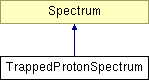
Inheritance diagram for TrappedProtonSpectrum:
Public Methods | |
| TrappedProtonSpectrum (float lat=0., float lon=0.) | |
| TrappedProtonSpectrum ( const std::vector<float>& params) | |
| virtual double | calculate_rate (double old_rate) |
| virtual double | flux () const |
| calculate the flux, particles/m^2/sr. (default zero). More... | |
| virtual float | flux (float lat, float lon) const |
| virtual float | flux (std::pair<double, double> coords) const |
| virtual float | operator() (float) const |
| virtual const char* | particleName () const |
| subclasses need to specify correct particle type. More... | |
| virtual std::string | title () const |
| return a title describing the spectrum. More... | |
| void | setPosition ( float lat, float lon ) |
Private Methods | |
| void | init (float lat, float lon) |
Private Attributes | |
| float | m_fluxTbl [73][13] |
| table of total flux vs. latitude and longitude. More... | |
Interface: In the constructor, latitude and longitude can be specified, either as two floats or by a pair. Coordinates are in degrees After a TrappedProtonSpectrum is constructed, the position can be modified by using the setPosition() member, passing it latitude and longitude either as two floats or as a pair. The pair form is especially useful in combination with an Orbit object. Flux in protons / (m^2 sec ster) is returned by the flux() member. Alternately, flux at a given position can be obtained by specifying the coordinates. The values are obtained by interpolating on a 5-degree grid, so finer detail should not be expected. Random samples from the energy spectrum (in GeV) can be obtained by using the () operator, supplying a random argument between 0 and 1. This behavior is found in all classes which inherit from Spectrum.
Expected usage: To obtain flux as a function of position, use flux(lat, lon) or flux(pair). To obtain spectrum samples, use (). The setPosition members and flux() (with no arguments) are probably of little utility. Patrick Nolan, Stanford University, 1998
Definition at line 40 of file TrappedProtonSpectrum.h.
|
|
Definition at line 17 of file TrappedProtonSpectrum.cxx. |
|
|
Definition at line 21 of file TrappedProtonSpectrum.cxx. |
|
|
Definition at line 65 of file TrappedProtonSpectrum.cxx. |
|
|
Definition at line 51 of file TrappedProtonSpectrum.cxx. |
|
|
Definition at line 35 of file TrappedProtonSpectrum.cxx. |
|
|
calculate the flux, particles/m^2/sr. (default zero).
Reimplemented from Spectrum. Definition at line 28 of file TrappedProtonSpectrum.cxx. Referenced by calculate_rate(), and flux(). |
|
|
Definition at line 70 of file TrappedProtonSpectrum.cxx. Referenced by TrappedProtonSpectrum(). |
|
|
Reimplemented from Spectrum. Definition at line 58 of file TrappedProtonSpectrum.cxx. |
|
|
subclasses need to specify correct particle type.
Reimplemented from Spectrum. Definition at line 84 of file TrappedProtonSpectrum.cxx. |
|
|
Definition at line 56 of file TrappedProtonSpectrum.h. Referenced by calculate_rate(). |
|
|
return a title describing the spectrum.
Reimplemented from Spectrum. Definition at line 88 of file TrappedProtonSpectrum.cxx. |
|
|
table of total flux vs. latitude and longitude.
Definition at line 62 of file TrappedProtonSpectrum.h. |
 1.2.3 written by Dimitri van Heesch,
© 1997-2000
1.2.3 written by Dimitri van Heesch,
© 1997-2000