#include <GaudiKernel/FindByMassRange.h>
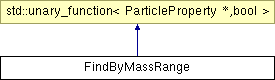
Inheritance diagram for FindByMassRange:
Public Methods | |
| FindByMassRange ( double low, double high ) | |
| Constructor - sets the mass range in Gev. More... | |
| bool | operator() ( const ParticleProperty* pp ) const |
| This routine check to see if the mass of a particle lies within the given mass range and returns true if it does. More... | |
Private Attributes | |
| double | m_low |
| Low and high mass range (GeV). More... | |
| double | m_high |
In this case it corresponds to pair< std::string, ParticleProperty* > as the ParticlePropertySvc stores all its data in a map. The string will be the map's key (usually the particle name) and the pointer is a pointer to the ParticleProperty object. The bool template argument states that operator() returns true or false.
The data is accessed in the following manner: const IParticlePropertySvc::value_type& pp_ref; std::string key = pp_ref.first; ParticleProperty* pp = pp_ref.second;
Definition at line 31 of file FindByMassRange.h.
|
|
Constructor - sets the mass range in Gev.
Definition at line 36 of file FindByMassRange.h. |
|
|
This routine check to see if the mass of a particle lies within the given mass range and returns true if it does.
Definition at line 41 of file FindByMassRange.h. |
|
|
Definition at line 55 of file FindByMassRange.h. |
|
|
Low and high mass range (GeV).
Definition at line 54 of file FindByMassRange.h. |
 1.2.3 written by Dimitri van Heesch,
© 1997-2000
1.2.3 written by Dimitri van Heesch,
© 1997-2000