
Description
The LAT Testbed is intended to exercise most of the LAT hardware and software. The major exceptions are the actual detectors (e.g., ACD, CAL, TRK).
For expository purposes, we will divide the Testbed's activities into four phases. Note, however, that a given test run may differ from the sequence shown below. For instance, the Front End Simulator (FES) may be instructed to loop, dumping the same Simulated Events again and again.
- Preparation
A Monte Carlo simulation is performed, generating files of Simulated Event data. Given that a simulated event occupies a kilobyte, and the simulation may exceed 10,000 events/second, the event data may flow through the FES at rates in excess of 10 MB/second.
Thus, a test run might contain 50-100 GB of Simulated Event data. Prior to the test run, this data must be loaded into the FES disk drives. The FES must then be asked to perform the desired type of download (e.g., continuous loop, single dump).
- Initiation
A Test Script is read by the Spacecraft (SC) Simulator, which passes commands to the Spacecraft Interface Unit (SIU) and the Event Processing Units (EPUs). Optionally, a one-bit "start-up" signal may be sent to the FES.
- Operation
Simulated Events are read by the FES computers and distributed, in a sequenced manner, to the Anti-Coincidence Detector (ACD) Electronics Module (AEM) and the Tower Electronics Modules (TEMs). If the GASU accepts the trigger information, it assembles the event data and passes it to the EPUs for filtering.
If the EPU accepts the event as "interesting", it passes the data back through the GASU to the Solid State Recorder (SSR) Simulator, which stores the Detected Events in a file.
- Analysis
After the completion of the test, the Simulated Events, Detected Events, and Test Log are analyzed to see if the system correctly handled the simulated event stream.
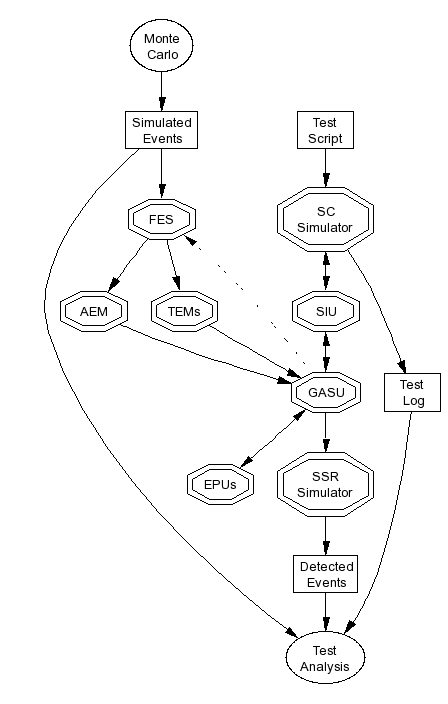
See also: annotated data flow animation