
Req. 5.3.11.4: "GRB Message to GBM"
The FSW shall send a command indicating the time of detection, for GRBs detected by the LAT.
Basis (help)
[11] (3.2.2)
-
11: "LAT-GBM Interface Control Doc." (NASA 433-ICD-0001)
3.2.2: "LAT TELECOMMANDS TO GBM"
Just as with the GBM, whenever a burst is detected, and predefined criteria are met, the LAT will send information to the ground and the GBM outside the standard science data path. The LAT will send a subset of the total information to the GBM for two reasons. First, so the GBM is aware that the 1 kbps downlink channel resource is being shared between the instruments and second, so GBM can choose to modify its data collection algorithms and/or preserve its buffered science data for recording to the SSR in the event it does not recognize or trigger on the burst.
3.2.2.1: "Packet Definitions"
A burst detection meeting the alert criteria will cause the LAT to send data in two different telecommand types:
1. L2GLATTRIGGER (one per burst alert) 2. L2GLATCLOSEOUT (one per burst alert)
For a LAT-detected burst alert, the LAT shall issue one L2GLATTRIGGER telecommand packet (sister packet to the L2GLATTRIGGER Alert Telemetry packet described in Chapter 4, Table 4-12) to the GBM. Only one L2GLATTRIGGER telecoLATTRIGGER telecommand is described in Table 3-4.
For a LAT-detected burst alert, LAT shall issue one L2GLATCLOSEOUT telecommand packet to the GBM. (This is the sister packet to the LATCLOSEOUT alert telemetry packet, as described in Chapter 4, Table 4-14.) The L2GLATCLOSEOUT shall be formatted as a telecommand and sent to the GBM as described in Table 3-5. The L2GLATCLOSEOUT shall be issued after a predetermined time period of below-threshold detection (a LAT configuration parameter) of at least one minute (or non-detection; this time period is not likely to exceed 10 minutes).
Once a L2GLATTRIGGER telecommand is issued, no further L2GLATTRIGGER telecommands shall be issued until after a L2GLATCLOSEOUT telecommand is issued (1).
(1) One possible exception to this is when the LAT is reset or power-cycled after a Trigger Record has been sent but before the Closeout Record has been sent. GBM and the ground system will probably want to know about such occurrences.
3.2.2.2: "Generic Telecommand Field Descriptions"
For simplicity, the header information format for LAT generated telecommands and telemetry packets is the same for all record types.
3.2.2.3: "L2GLATTRIGGER Telecommand"
One L2GLATTRIGGER telecommand per burst is sent to the GBM (and a corresponding Alert Telemetry Packet is sent to the ground).
3.2.2.4: "L2GLATCLOSEOUT Telecommand"
One L2GLATCLOSEOUT Telecommand per burst is sent to the GBM.
Note: A corresponding Alert Telemetry packet (see Section 4.2.4) is sent to the SC for transmission to the ground.
Context (help)
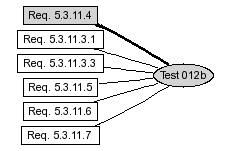
Test(s)
012b: Additional Science Processing - Repointing Logic
This test verifies the LAT's internal logic for requesting repointing for LAT-detected GRBs. Verification shall include a variety of scenarios, including repointing enable, different operational modes, and conflicting requests. The test shall verify that the SIU FSW responds to these events properly, forwarding repointing requests to the SC, sending a command indicating the time of GRB detection, and (for a LAT-detected burst alert) issuing a LAT closeout message to the GBM.