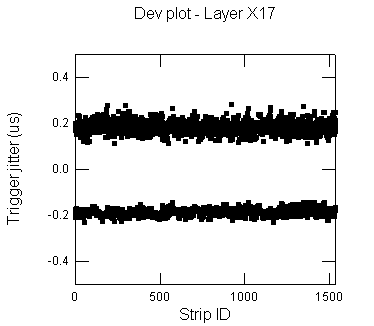
Upper band=0.5 MIP Qinj giving later trigger time and more jitter.
Lower band=5 MIP Qinj giving earlier trigger time and less jitter.
In the original trigger requirement specification, the spec for the TKR trigger jitter was vaguely defined as 250ns. The primary concern was the effect of trigger jitter on the CAL data latching sliding off the peak which might degrade resolution. Another concern was the extended GEM window opening time to ensure trigger latching at larger jitter would also delay the data latching TACK, which is already rather late for the TKR itself such that it might lose some low pulse height TKR hits.
The standard TKR jitter tests are performed using charge injection at two different levels on each single TKR layer: one corresponding to the very low pulse height of ~0.5 MIP (Qinj DAC=37 range=0 ~2.7fc), the other at a very high pulse height of ~4 MIP (Qinj DAC=63 range=1 ~20fc), while the threshold was set to ~1/4 MIP (threshold DAC ~30 range 0, ~1.4fc). Because the simple threshold for triggering, there is an expected time slew for different pulse heights. The typical TKR jitter test show that the the mean trigger time differ by ~400ns,
|
|
Standard TKR jitter test Upper band=0.5 MIP Qinj giving later trigger time and more jitter. Lower band=5 MIP Qinj giving earlier trigger time and less jitter. |
while the channel to channel variation is much smaller. The example full result page for a tower can be found here. The GTFE pulse shape below indicate a peak time of ~1.5-2.0ms after the initial hit. The 5 MIP pulse height hits should appear very close to t=0, while with the threshold at half way up the peak for the 1/2 MIP case, it is indeed consistent with an expectation of being late by ~400ns on average.

With the TKR jitter tests on single layers indicating a time span of 400ns (8 ticks) for hits, while our standard vertical muon time-in for TKR triggers showing jitters as low as s<1 tick, it is reasonable to ask how do we reconcile the two results and which is more relevant ?
The vertical muon triggered by muon telescope in the trigger time-in tests are mostly through all 18 layers, and taking the earliest from the many available 3-in-a-row combinations makes TKR trigger time earlier and with less jitter in this ideal situation, as seen from our STR2 test results:
 |
Muon telescope trigger without delay.
Enable only a finite number of consecutive layers for TKR 3-in-a-row trigger (except the case of single layer tests, all other layers are enabled). |
Some interesting readings from these test results (for vertical muons):
However, the vertical muons may be not exploring the worst case yet ? Some topologies to consider:
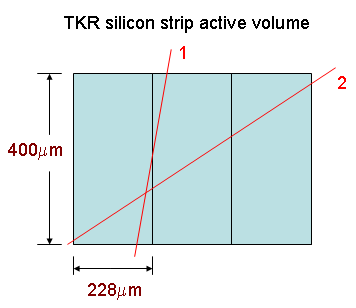 |
In case 1), each hit is only got 200mm
silicon, but there are two chances.
In case 2), the silicon thickness per hit is also short, but there are 2 or more chances. Case 2) should be not worse than case 1) and the vertical muons do include fair number of case 1) layers. Even for vertical muons, track tilt along the strips too which adds some useful ionization length.
|
The term 'MIP' refers to 400mm silicon, so that the 1/2 MIP test at single hit level is relevant as seen in both cases above, but it is the worst single hit case (excluding wafer edge effects). To translate ionization path length into pulse heights, can look at ionization straggling calculations a la Hans Bichsel (See Mod. Rev. Phys. 60, p663 (1998)):
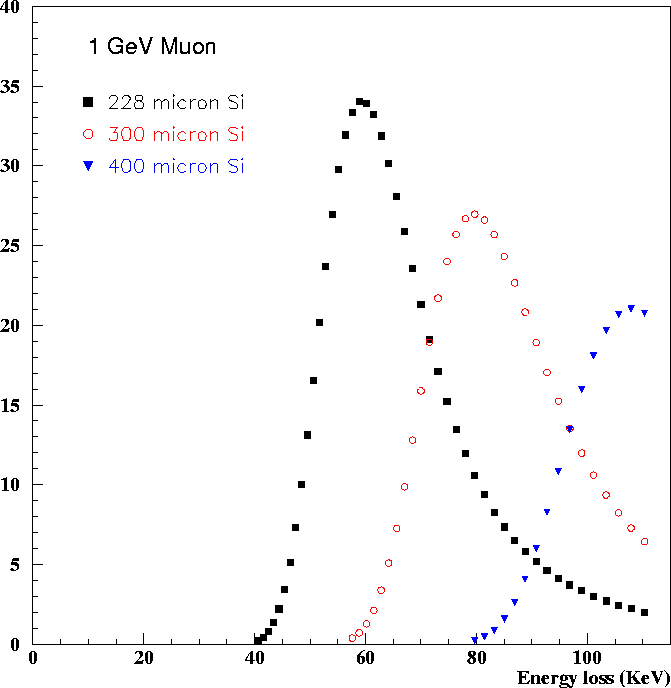
Fortunately, fluctuations toward lower pulse height is limited. Given other factors tend to push for longer ionization path lengths, 1/2 MIP signal is the right worst case level to test. A much more complicated question is how the low pulse height 1/2 MIP signals affect a real track trigger ? Modelling just based on STR2 tests is rather difficult. Looking into more data and future STR might help. Need good arrival time info for well controlled tilted short tracks.
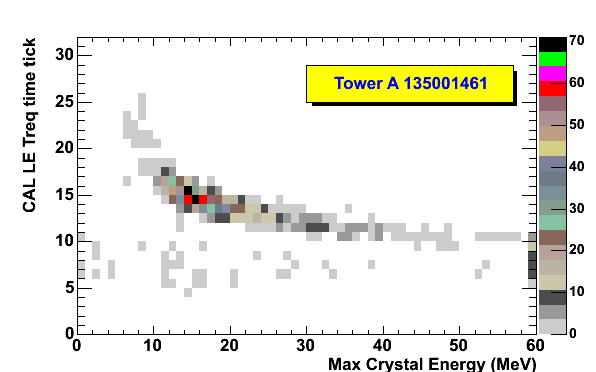
CAL trigger also has a threshold slew effect, which could be >10 ticks if one wants to rely on hits very close to threshold (this effect will be present :
How much jitter do we really care ?
The ground muon tests are not seeing all situations to confront in space:
Would not be a surprise that we have to adjust mean time alignments or lengthen GEM window in flight to accomodate additional source of dispersion of trigger time. GEM window will remain 12 ticks or possibly longer.
Hit latching from TACK scan result:
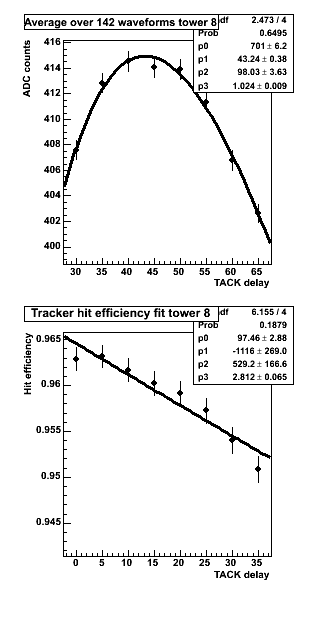 |
CAL energy latching fall-off for a trigger window of +6
ticks is <0.5%
TKR hit latching efficiency fall-off is <<0.5% for extra TACK delays up to 15 ticks.
|
Conclusion: