
Req. 5.3.15: "Mode Control"
The SIU FSW shall support the observatory modes of (1) sky survey, (2) pointed observation, (3) repointed observation, and (4) engineering, in addition to Safe Mode and any required special modes for in-orbit checkout.
Basis (help)
[1] (3.1.2.2-3, 3.1.3.2.3, 3.3.2.1.1-2, 3.3.2.2-4, 3.3.3), [3] (5.3.5)
-
1: "Mission System Spec." (NASA 433-SPEC-0001)
3.1.2.2: "Observation Modes"
The GLAST system shall acquire science data in 3 basic observation modes, sky survey mode, pointed observation mode, and repointed observation mode.
3.1.2.3: "Targets of Opportunity"
The GLAST system shall accommodate requests submitted by the scientific community to observe targets of opportunity.
3.1.3.2.3: "System Checkout and Test On Orbit"
The GLAST system shall support system checkout and tests in different on/off and operational configurations of observatory system components.
3.3.2.1.1: "Ground Commanded Repointing"
The observatory shall be capable of repointed observations in all modes of observation upon ground command.
3.3.2.1.2: "GRB Alert Transmission"
The observatory shall transmit GRB alert messages in all modes of observation.
3.3.2.2: "Sky Survey Mode"
3.3.2.2.1: "Orbit Fixed Referenced Pointing"
The desired pointing direction of the +Z axis of the observatory shall be defined with respect to the orbit fixed frame. The desired rocking angle may be piecewise constant, or may vary slowly (small multiples of orbit frequency) with time.
3.3.2.2.2: "Rocking"
Rocking angle offsets of the observatory Z-axis shall range from -60 deg. to 60 deg.
3.3.2.2.3: "Pointing Accuracy"
The observatory shall maintain the +Z-axis to within 2 degrees, 1 sigma, radial, with a goal of 0.5 degrees, of its commanded direction.
3.3.2.2.4: "Sky Coverage"
The observatory shall be capable of scanning the LAT field of view (55 degree half-angle) over >90% of the celestial sphere repetitively on selectable timescales as short as every 2 orbits.
3.3.2.2.5: "Data Acquisition"
Downlink transmissions of science data shall not degrade the on-going acquisition of science data.
3.3.2.2.6: "Downlink Transmission"
Downlink transmissions of science data shall not be interrupted by a repointing candidate request from the science instruments.
3.3.2.2.7: "Mode Transitions"
Transition to and from sky survey mode shall occur upon real-time ground command or delayed-time stored command.
3.3.2.3: "Pointed Observation Mode"
3.3.2.3.1: "Pointing Accuracy"
The observatory shall maintain pointing of the observatory +Z axis to within 2 degrees, 1 sigma, radial, with a goal of 0.5 degrees, 1 sigma, radial, of its commanded pointing direction.
3.3.2.3.10: "Mode Transitions"
Transition to and from pointed observation mode shall occur upon real-time ground command or time-delayed stored command.
3.3.2.3.2: "Earth Avoidance Angle"
The Earth Avoidance Angle shall be a parameter that is adjustable on orbit.
3.3.2.3.3: "Earth Avoidance Angle Initial Value"
The initial value of the Earth Avoidance Angle shall be 30 degrees.
3.3.2.3.4: "Earth Avoidance Constraint"
The observatory shall not point the +Z observatory axis to within the Earth Avoidance Angle of any portion of the Earth, except during a repointing slew or by ground command.
3.3.2.3.5: "Target Within the Earth Avoidance Angle of the Earth"
When the observation target is unocculted but within the Earth Avoidance Angle of the Earth, the observation target shall be maintained within the Earth Avoidance Angle of the +Z Observatory axis.
3.3.2.3.6: "Pointing Adjustment"
When the observation target is occulted, or unocculted but within the Earth Avoidance Angle of the Earth, the commanded pointing direction shall be adjusted by the spacecraft to accommodate the Earth avoidance constraint.
3.3.2.3.7: "Secondary Target Repointing"
The observatory shall have the capability to slew and point to a secondary target (if previously identified) when the primary target is occulted by the Earth.
3.3.2.3.8: "Primary Target Repointing"
The observatory shall return from a secondary target to its primary target when the primary target is no longer occulted by the Earth.
3.3.2.3.9: "Downlink Transmissions"
3.3.2.3.9.1: "Priority"
Downlink transmissions of science data in pointed observation mode shall take priority over on-going pointed observations.
3.3.2.3.9.2: "Interruption of Pointed Observation"
An on-going pointed observation may be interrupted to meet the pointing constraints for downlink transmissions of science data.
3.3.2.4: "Repoint Mode"
3.3.2.4.1: "Autonomous Repointing"
The observatory shall be capable of repointing autonomously from either sky survey mode or pointed observation mode in response to GRBs detected on board.
3.3.2.4.1.1: "Go/No-Go Decision Making"
The observatory shall be capable of go/no-go decision making in response to on-board repointing commands.
3.3.2.4.1.2: "Automatic Resume"
Upon completion of a repointed observation that is performed autonomously, the observatory shall automatically resume the previously interrupted observation (sky survey or pointed observations).
3.3.2.4.2: "Targets of Opportunity"
The observatory shall accept repointing commands from the ground to acquire Targets of Opportunity.
3.3.3: "Maintainability Requirements"
3.3.3.1: "Normal Maintenance Information"
The observatory shall normally report telemetry relevant to its health.
3.3.3.2: "Information for Diagnostics and Anomalous Conditions"
The observatory shall have the capability to increase the rate and amount of any or all engineering telemetry to the degree necessary to support observatory diagnostics and to troubleshoot anomalies or failures.
3.3.3.3: "Reconfiguration for Trouble Shooting"
To assist in troubleshooting anomalies or failures, the observatory shall have the capability to safely reconfigure its state by command. (Such state changes may include but are not limited to the attitude of the observatory, the position of movable hardware, battery charge rates, power to heaters, power to various equipment and so forth.)
3.3.3.4: "Impact on Science"
3.3.3.4.1: "Diagnostics and Troubleshooting"
The observatory shall include functionalities to enable mission operations personnel to conduct diagnostics and troubleshooting procedures.
3.3.3.5: "Software Uploads"
The observatory shall accommodate software uploads for the instruments and the spacecraft.
3.3.3.6: "Real Time Communications"
The observatory shall support full-orbit coverage via TDRSS for real-time telemetry and command.
5.3.5: "Operating Modes"
The SI shall accommodate the observatory modes of operation identified in the GLAST Mission System Specification (MSS), Section 3.1.15, Modes of Operation. These modes are Sky Survey Mode, Pointed Observation Mode and Safe Mode. Additionally, the instrument must accommodate the spacecraft load shedding function identified in the SI/SC IRD, Section 3.2.7, Fault Protection.
Context (help)
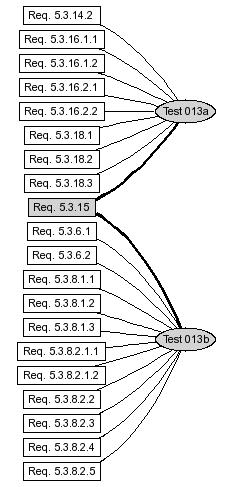
Test(s)
013a: Operational Modes - Safe Modes
This test shall verify that the SIU FSW can perform the correct transition of the LAT into Safe Mode upon command, can properly execute the Safe Mode algorithms, and can perform the subsequent recovery via Engineering Mode. It shall also verify the correct response to SAA entry commands and subsequent recovery.
013b: Operational Modes - Science Modes
This test shall verify correct transitions between the various science observation modes and proper operation of the LAT in those modes. The test shall involve all observation modes: Sky Survey Mode (non-rocking as well as various rocking profiles), Pointed Observation Mode, and Repointed Observation Mode.